| Publisher |
Tulika Books |
| Publication Year |
2022 |
| ISBN-13 |
9789382381716 |
| ISBN-10 |
9382381716 |
| Binding |
Paperback |
| Number of Pages |
108 Pages |
| Language |
(English) |
| Weight (grms) |
168 |
| Subject |
Indian History |
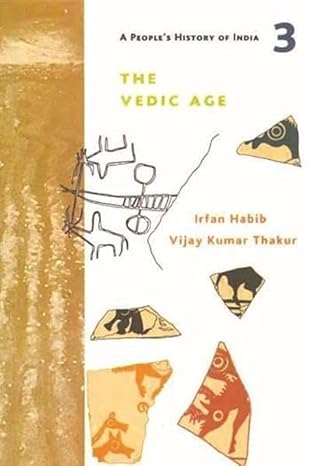
The Vedic Age completes the first set of three monographs in the People's History of India series. It deals with the period c. 1500 to c. 700 bc, during which it sets the Rigveda and the subsequent Vedic corpus. It explores aspects of geography, migrations, technology, economy, society, religion, and philosophy. It draws on these texts to reconstruct the life of the ordinary people, with special attention paid to class as well as gender. In a separate chapter, the major regional cultures as revealed by archaeological evidence are carefully described. Much space is devoted to the coming of iron, for the dawn of the Iron Age - though not the Iron Age itself - lay within the period this volume studies. There are special notes on historical geography, the caste system (whose beginnings lay in this period) and the question of epic archaeology. A special feature of this monograph is the inclusion of seven substantive extracts from different sources, which should give the reader a taste of what these texts are like.
Irfan Habib
Irfan Habib is an Indian historian of ancient and medieval period. He is known for his Marxist leanings and criticism of Hindu and Islamic fundamentalism. He attended the Aligarh Muslim University School and did his B.A. and M.A. in history from the same university where he was awarded a double first class. He later did his Ph.D. from New College, Oxford. He has been the recipient of many awards like The Watumull Prize in 1982. He was awarded the Padma Bhushan in 2005.



Irfan Habib
Tulika Books